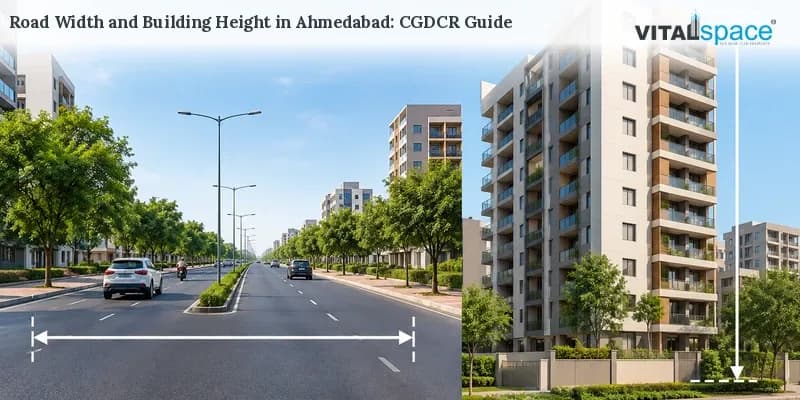
Have you noticed that a 20-storey tower can rise on one road while the next street only has four-floor buildings? In most cases, the reason is road width. Road width and building height in Ahmedabad are closely linked under Gujarat's Comprehensive General Development Control Regulations (CGDCR), and the link affects everything from a project's skyline to whether shops are allowed on the ground floor.
Understanding these rules can be useful when exploring residential projects in Ahmedabad, especially along major roads such as SG Highway, where road width can influence building height and permitted development.
Why road width decides what can be built?
A wider road can safely handle more traffic, more parking movement and, most importantly, fire tenders and emergency vehicles. Taller buildings bring more residents, more cars and a greater need for quick emergency access. So the regulations allow height to grow only as the road in front of the plot gets wider.
Think of it this way. A narrow 30 ft lane can comfortably serve a few bungalows or a small apartment block. A 120 ft road can serve a cluster of high-rise towers, offices and shops, because it has the space to carry them.
Road width works alongside FSI (Floor Space Index). FSI controls how much total floor area can be built on a plot, while the road-width rules cap how tall the building can go. Our earlier guide on what FSI means explains that side in detail.
Building height by road width: the CGDCR table
The CGDCR 2017 Planning Regulations (Table 6.23) set the maximum building height by road width for D1 category authorities, which include AUDA. Here is a simplified version, with approximate road widths in feet as people commonly describe them.
Road width | Approx. in feet | Maximum building height |
Less than 9 m | Under 30 ft | 10 m (12 m for DW1/DW2 residential) |
9 m to under 12 m | 30 ft to under 40 ft | 16.5 m |
12 m to under 18 m | 40 ft to under 60 ft | 30 m |
18 m to under 36 m | 60 ft to under 120 ft | 45 m |
36 m and above | 120 ft and above | 70 m |
A footnote to the table allows up to 70 m on roads of 18 m and wider within a high-density development area, which the regulations define as land within 200 m of the road edge where the maximum permissible FSI is more than 3.5.
What can be built on a 40 ft road?
A 40 ft road is about 12.19 m wide, so it falls in the 12 m to under 18 m band. That allows a building of up to 30 m. As a rough guide, at about 3 to 3.5 m per floor including the slab, that is around eight to nine floors above ground, depending on the design, plinth and parapet. This is why many mid-rise apartment projects in established areas sit on roads of this width.
What can be built on a 60 ft road and wider?
A 60 ft road is about 18.29 m wide, which moves it into the 18 m to under 36 m band with a 45 m height limit. That is roughly 13 to 14 floors on the same rough guide, and more where the high-density footnote applies. Roads of 36 m (about 120 ft) and wider allow 70 m, which is where you usually see the tallest residential towers along major corridors.
Please note: the width that counts is the official road width in the development plan or town planning scheme, not simply what you see on site. Rules also change from time to time, so always confirm the current position with the local authority or a licensed architect.
Commercial use and road width
Road width also decides whether shops, showrooms and offices can be part of a building. Under CGDCR Table 6.4 (for areas outside the walled city and gamtal), the rules for commercial use are:
• Below 9 m: commercial use is not listed as permitted.
• 9 m to under 12 m: commercial use on the ground floor only.
• 12 m to under 18 m: commercial use on the ground and first floors only.
• 18 m and above: commercial use on all floors.
A note to the table allows commercial use on the ground and first floors of an existing building, or of a building on a road of 12 m or less, if a 7.5 m setback from the road centre line is kept and that setback land is handed over to the authority without compensation.
For buyers, this explains a pattern you may have noticed. Mixed-use projects with a retail podium usually sit on 60 ft and wider roads, while quieter residential lanes tend to have few or no shops.
Taller towers above 70 metres
Ahmedabad's skyline has changed fast in the last few years. Buildings such as Z Luxuria (145 m), The 31st (133.75 m) and Times 104 (130 m) are listed among the city's tallest residential towers. These go well beyond the 70 m limit in the table.
That is possible because Gujarat introduced a separate route for very tall buildings. As reported in August 2020, structures above 100 m in Ahmedabad and other major cities need a minimum plot of 2,500 sq m for 100 to 150 m and 3,500 sq m above 150 m. They also need approval from a special technical committee, a disaster management plan and a wind tunnel test of a model of the building.
The rules keep evolving. In August 2026, Ghar.tv reported a CGDCR amendment for Ahmedabad that includes a minimum 2 m staircase width for commercial buildings and a 12 m height cap for bungalows, with taller residential buildings to be treated as apartments with fire safety and NOC requirements. The report was unclear on whether every part is final, so check the official notification.
What road width means for flat buyers
When exploring flats for sale in Ahmedabad, understanding road width and building height can help you evaluate a property's surroundings and future development possibilities.
• It explains the skyline. If a new tower is planned on a wide road near your shortlisted project, your view may change over time. Check the road widths around you.
• It shapes the living experience. Wider roads usually bring more traffic and commercial activity. Inner roads are often quieter, with lower buildings.
• It affects what comes up next door. A 9 m lane cannot take a high-rise, so neighbouring plots are likely to stay low-rise under the current rules.
• It matters for redevelopment. For older societies, the road width in front of the plot is one of the first things a developer looks at, because it decides how much height and commercial space is possible.
• It links to safety. Taller buildings come with stricter fire safety needs, such as refuge areas and more staircases. Our guide on refuge areas covers this.
FAQs
What is the maximum building height on a 40 ft road in Ahmedabad?
A 40 ft road is about 12.19 m wide. Under CGDCR Table 6.23 for AUDA, roads of 12 m to under 18 m allow a maximum height of 30 m.
How tall can a building be on a 60 ft road?
A 60 ft road is about 18.29 m, which allows up to 45 m. Within a notified high-density development area, 70 m may be permitted on roads of 18 m and wider.
Can shops be built on a 9 m road?
Under CGDCR Table 6.4, roads of 9 m to under 12 m allow commercial use on the ground floor only. Below 9 m, commercial use is not listed as permitted, subject to the setback note in the regulations.
Do these rules apply in Gandhinagar and GIFT City?
Not always. This guide covers the D1 table that applies to AUDA. Gandhinagar and GIFT City have their own authorities and regulations, so check with them for a specific plot.
Final word
Road width is one of the important factors that influence building height and permitted commercial use in Ahmedabad. Understanding how these rules work can help you evaluate a property's surroundings, assess future development possibilities and ask better questions before buying a flat.
However, road width alone does not determine what can be built on a plot. The applicable CGDCR provisions, permissible FSI, plot conditions, fire-safety requirements and other approvals also matter.
Before making a property decision, verify the official road width and applicable development permissions with the relevant local authority or a licensed architect. A little due diligence today can help you make a more informed decision tomorrow.
Disclaimer
This article is for general information only. While we try to keep it accurate, we cannot guarantee that all information is 100% complete or correct. Some content has been prepared with the help of AI tools and publicly available sources, and project details may change without notice. Please verify all information yourself, including on the GujRERA website and with the developer, before making any property-related decision. RERA: AG/GJ/AHMEDABAD/AHMEDABAD CITY/AUDA/AA00842/160429R2