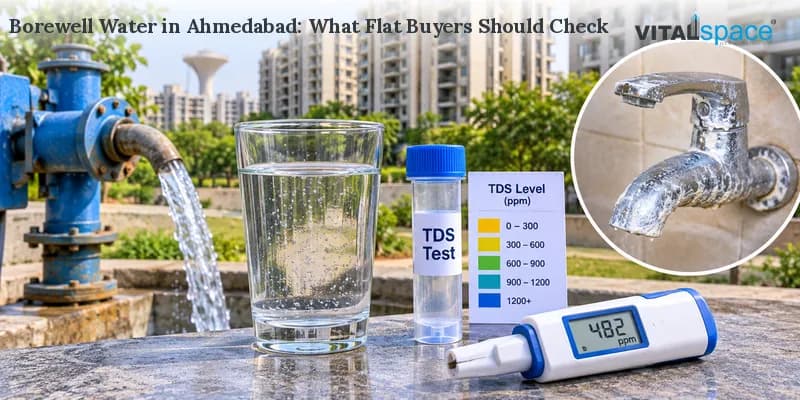
Most buyers spend hours on floor plans and amenities, and only a few minutes on water. Yet borewell water in Ahmedabad is one of the things that shapes daily life in a flat the most. It decides whether your taps get white crusts, how often the geyser needs descaling, and what you'll spend on filters every year.
A common question we get at site visits is, "Is this society on Narmada water or borewell?" Sometimes the answer is both. This guide explains where the city's water comes from, what the common borewell water problems are, and exactly what to ask before you book.
Explore flats for sale in Ahmedabad to compare available homes across different localities.
In this article
1. Where Ahmedabad's water comes from
2. Borewell water in Ahmedabad: common problems in flats
3. TDS and hardness: the numbers to know
4. How to check water supply before buying a flat
5. Living with borewell water: practical fixes
6. FAQs
Where Ahmedabad's water comes from?
Most of the city's piped water comes from the Narmada canal system, not from the ground. The Amdavad Municipal Corporation's water department lists its sources like this:
Source | Capacity | In use |
Kotarpur plant (Narmada main canal) | 830 MLD | 830 MLD |
Jaspur plant (Dholka branch canal) | 400 MLD | 395 MLD |
Raska plant (Shedhi branch canal) | 200 MLD | 200 MLD |
AMC borewells (598) | 500 MLD | 110 MLD |
French wells (7) | 170 MLD | 0 MLD |
MLD means million litres a day. So out of about 1,535 MLD in use, borewells supply roughly 110 MLD, around 7 per cent. AMC's own page says it plans to reduce groundwater use in the coming years, and new treatment plants are under way at Kotarpur (300 MLD) and Jaspur (200 MLD).
The network is also reaching newer areas. In April 2025, AMC took over 24x7 water supply in Bopal and Ghuma from AUDA, covering over 1.75 lakh residents.
Homebuyers can also explore flats for sale in Bopal and flats for sale in Ghuma to compare available residential options.
In February 2026, AMC announced a ₹80 crore, 100 MLD plant at Raska for the newly merged eastern areas from Vastral to Kamod, where residents have relied heavily on borewells. It should serve about five to six lakh people once running.
Borewell water in Ahmedabad: common problems in flats
Groundwater picks up minerals as it passes through soil and rock. That's why borewell water usually tastes and behaves differently from treated canal water. Here's what residents tend to notice:
• White, chalky marks on taps, tiles and glass shower panels. This is hardness, mostly calcium and magnesium.
• Scale inside geysers, washing machines and kettles, which makes them work harder and wear out sooner.
• A slightly salty or flat taste, often a sign of higher dissolved solids.
• Soap and shampoo that don't lather well.
• Lower supply in peak summer, when the water table drops and more water is pumped.
Supply is a longer-term point too. A Gujarat Samachar report based on the Central Ground Water Board's 2023 assessment said Ahmedabad was using 152 per cent of its extractable groundwater, which places it in the "over-exploited" category. In plain terms, more water is taken out each year than rain puts back. Over time, borewells may need to go deeper. That's one reason AMC is shifting the city towards Narmada-based supply.
Quality also varies a lot from place to place. An older CGWB district brochure (2014, using 2012 samples across Ahmedabad district, including rural areas) recorded TDS readings from 541 mg/l at one point to 8,435 mg/l at another. Two borewells a few kilometres apart can give very different water, so a test report for the actual society matters more than any area average.
TDS and hardness: the numbers to know
TDS stands for total dissolved solids. It's the total amount of minerals and salts in the water, measured in milligrams per litre (mg/l). A cheap handheld TDS meter gives a quick reading, but a lab test tells you what those solids actually are.
India's drinking water standard, IS 10500:2012, sets these limits:
Parameter | Acceptable limit | Permissible if no other source |
TDS | 500 mg/l | 2,000 mg/l |
Hardness (as CaCO3) | 200 mg/l | 600 mg/l |
Fluoride | 1 mg/l | 1.5 mg/l |
Chloride | 250 mg/l | 1,000 mg/l |
Nitrate | 45 mg/l | No relaxation |
A quick example. If a society's test shows TDS of 1,200 mg/l and hardness of 450 mg/l, the water is within the permissible range but well above the acceptable one. It will usually be fine for washing and bathing with a softener, and you'll want RO or another purifier for drinking. If fluoride or nitrate is above the limit, that needs proper treatment, not just a softener.
How to check water supply before buying a flat?
We recommend treating water like any other legal or technical check. Ask for answers in writing where you can.
What to ask | Why it matters |
What is the water source: AMC or AUDA line, borewell, or both? | Tells you what you'll actually get from day one |
Is the municipal connection sanctioned or only applied for? | Applied is not the same as flowing |
Is there approval for the borewell? | Reports say prior approval is needed, with fines of up to ₹1 lakh for violations |
Can I see a recent lab test report? | Shows TDS, hardness, fluoride and nitrate for that borewell |
Is there a softener or treatment plant for the society? | Affects maintenance charges and appliance life |
How much storage do the tanks hold? | Helps during supply cuts or canal repair days |
For ready projects, talk to two or three existing residents. Ask how the water was in May and June, not just this week. For under-construction projects, ask the builder what the water plan is for possession day and for later, once the municipal network arrives.
Living with borewell water: practical fixes
If you like a flat but it runs on borewell water, that alone needn't stop you. Most issues can be managed with the right setup:
• A central softener for the society, or one for your flat's bathrooms, cuts scale on fittings and geysers.
• An RO or similar purifier in the kitchen for drinking and cooking.
• Regular descaling of geysers and cleaning of overhead tanks.
• A water test at least twice a year, before and after the monsoon, since quality can change with the water table.
Ask the society what the treatment plant costs to run each month. It's a fair line to include when you compare maintenance charges between projects.
Rules on borewells and water connections can change, and they differ between AMC, AUDA and other authorities. Please confirm the current position with the local authority or a licensed professional before you rely on it.
FAQs
Is borewell water in Ahmedabad safe to drink?
It depends on the specific borewell. Get a lab test and compare it with IS 10500 limits. Even when it's within limits, most families use an RO or similar purifier for drinking and cooking.
What is a good TDS level for drinking water?
Under IS 10500:2012, up to 500 mg/l is acceptable. Up to 2,000 mg/l is permissible only where no other source is available.
Do new projects in Ahmedabad get Narmada water?
Many do, through AMC or AUDA lines, but it depends on the location and the pipeline network. Ask the builder whether the connection is sanctioned or only applied for.
Can a housing society dig its own borewell?
News reports say prior approval is needed to build a borewell, with fines of up to ₹1 lakh for violations. Check the current rules with the local authority and ask the society for its approval papers.
Final word
Borewell water in Ahmedabad isn't a reason to reject a good flat, but it is a reason to ask better questions. Find out the source, see a recent test report, and check what treatment the society runs. Two minutes with a TDS meter at the site can save you years of scaled taps and surprise bills.
Explore residential properties in Ahmedabad to compare homes in different locations.
Disclaimer
This article is for general informational purposes only. While we strive to keep the information accurate and up to date, we cannot guarantee its completeness or accuracy. Some content has been prepared using AI tools and publicly available sources. Water quality, supply conditions and local regulations may change over time. Readers are advised to verify relevant information with the concerned authorities, water suppliers or qualified professionals before making any decisions.